Check out what the students in Mrs. VandenBush's classroom are doing in art! Some of th lesson ideas I come up with, but many of these ideas come from other wonderful art teachers!
Friday, January 18, 2013
2nd Grade: Winter Landscapes
The 2nd grade students learned all about LANDSCAPES. Students were able to find the three parts of a landscape: foreground, middle ground and background in many different examples. They learned that the objects in the foreground or front are the largest and closest to the bottom, the objects that are a little smaller are in the middle ground, and the objects that are the smallest and farthest up are in the background. Students also learned about the COOL COLORS and discussed what kind of mood or feeling they get from these colors. Student then were able to create their very own landscape and created DEPTH by using different size trees and making sure they placed the largest trees in the foreground and the smaller trees in the background.
1st Grade: Snowflakes
The 1st grade students learned all about snowflakes. We discussed the process of rain freezing to create snowflakes. They also learned that there are not two snowflakes that are exactly the same. Students also learned that snowflakes have RADIAL BALANCE which is creating the same line/design around the entire snowflake. Students were able to create radial balance in each snowflake they created. Students were able to add VARIETY to their art by creating different sizes of snowflakes. Finally students learned what the COOL COLORS are and brainstormed different things that reminded them of the cool colors.
5th Grade: Skateboard Design
The 5th grade students learned about logos and product design. They were able identify popular logos in our culture. We looked at many examples and talked about characteristics for a great design. Students were able to use various shapes, colors, patterns, textures to create a unique design. We talked about how to make a design stand out by using complimentary colors. Students had to create a design for a skateboard without using a design or logo that currently exists.
3rd Grade: Klimt Trees
Gustav
Klimt was an amazing artist! He was born
and lived in Vienna, Austria with his family.
His father was a gold carver and engraver. He had two brothers and four sisters. His family did not have a lot of money
growing up, so he was able to get a scholarship to attend the Vienna School of
Decorative arts. He did this at the age
of 14 for seven years. When he finished
school he opened his own studio with a friend and one of his brothers, and they
began to paint murals. They started to
get paid for their work and soon Klimt began to become recognized as an
artist. He started to paint portraits of
women with elaborate gowns and blankets as well as landscapes. His father’s work also influenced his art
because he began to use the color gold in many of his paintings. He used a lot
of organic shapes, lines and patterns.
Gustav Klimt is one of the few artists we’ve studied that actually sold
his artwork to make a living!
1st Grade: Klimt Quilts
Gustav Klimt was an amazing artist! He was born and lived in Vienna, Austria with his family. His father was a gold carver and engraver. He had two brothers and four sisters. His family did not have a lot of money growing up, so he was able to get a scholarship to attend the Vienna School of Decorative arts. He did this at the age of 14 for seven years. When he finished school he opened his own studio with a friend and one of his brothers, and they began to paint murals. They started to get paid for their work and soon Klimt began to become recognized as an artist. He started to paint portraits of women with elaborate gowns and blankets as well as landscapes. His father’s work also influenced his art because he began to use the color gold in many of his paintings. He used a lot of organic shapes, lines and patterns. Gustav Klimt is one of the few artists we’ve studied that actually sold his artwork to make a living!
Thursday, November 15, 2012
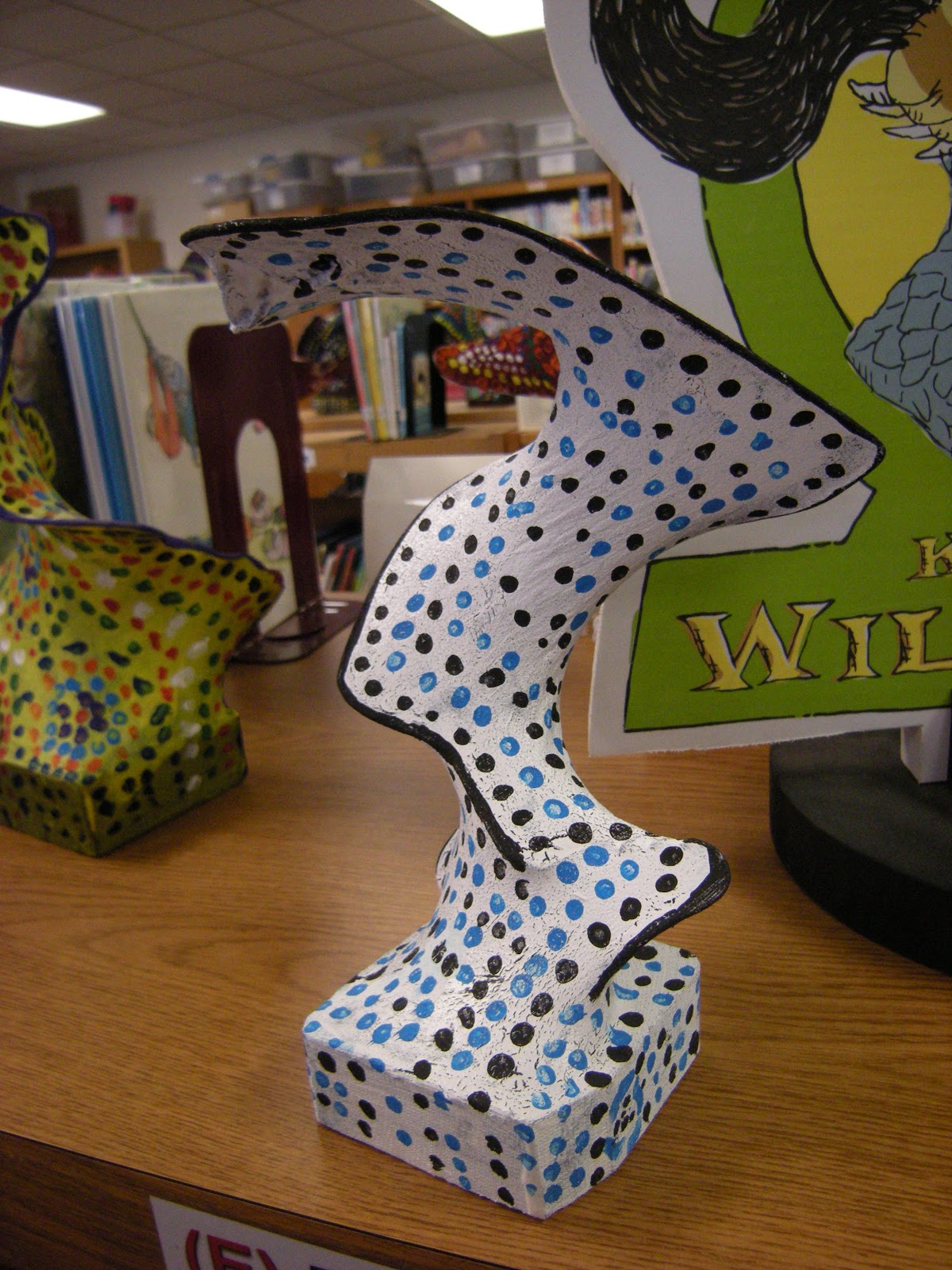
5th Grade Aboriginal Sculptures
Aboriginal
art originates from Australia over 30,000 years ago. Aborigines began painting on rocks and inside
caves with earth tone or neutral colors.
Students learned that back then they couldn’t go to the store to buy
paint; they had to find things in nature to make their own paint. Today Aboriginal Art has three main
characteristics, dots, symbols and/or animals.
Aborigines filled their space and did not leave any negative (empty
space) in their art. The Aborigines used
symbols in their art to document their travels and experiences. Students learned that different
countries/cultures have different meanings for different symbols. Students were also introduced to REPITION
and UNITY and how to create/find that in a piece of art. The 5th grade students review the
difference between 2-D and 3-D art. We
also talked about Abstract Art and what it means. Students were able to create sculpture using
a hanger, nylon and block of wood.
Students could choose any colors of their choice but had to fill their
sculpture with dots and symbols to represent Aboriginal Art.
4th Grade Aboriginal Animals
Aboriginal
art originates from Australia over 30,000 years ago. Aborigines began painting on rocks and inside
caves with earth tone or neutral colors.
Students learned that back then they couldn’t go to the store to buy
paint; they had to find things in nature to make their own paint. Today Aboriginal Art has three main
characteristics, dots, symbols and/or animals.
Aborigines filled their space and did not leave any negative (empty
space) in their art. The Aborigines used
symbols in their art to document their travels and experiences. Students learned that different
countries/cultures have different meanings for different symbols. Students were also introduced to REPITION
and UNITY and how to create/find that in a piece of art.
The
4th grade students had to choose an animal native to Australia to
have as the focal point of their art.
Students create various aboriginal symbols throughout their animal and
background using dots. Students had to
fill their background space with dots and patterns.
Subscribe to:
Posts (Atom)